MAE 3 Autonomous Competition Robot
MAE 3 (Introduction to Mechanical Engineering Design) is a foundational UC San Diego course typically taken during a student's first year, intentionally designed to throw beginners straight into rigorous engineering design and manufacturing with zero prior experience expected. Over an intensive 10-week quarter, students learn the complete hardware development lifecycle from scratch, starting with a 3.5-week individual pendulum clock build before jumping into a high-stakes, 6.5-week team robotics challenge. Because no previous shop or software background is assumed, the course rapidly builds hands-on proficiency in hand sketching, 2D and 3D CAD (AutoCAD and Autodesk Inventor), laser cutting, basic machine shop fabrication (drilling, tapping, reaming, and press fits), mechanical power transmission, and engineering physics analysis.
Where
La Jolla, CA
When
April 2025 - June 2025
Meet Our Robot!
The Robot Competition
The Objective: In fast-paced, 60-second head-to-head matches, teams had to collect rings across the playing field and place them onto a central Sun God statue, where higher placement tiers awarded up to 50x point multipliers and three shared pink rings served as tiebreakers.
Size and Structure: Robots had to start completely inside a 10x10x10-inch bounding box, expanding only under their own power once play began, and remain a single connected body throughout the match.
Materials and Fabrication: Machines were built strictly from a standard hardware kit (acrylic, aluminum, springs, fasteners, and up to six DC motors) alongside a limited volume of custom 3D-printed PLA parts.
Power and Control: Each robot was tethered to a 5V DC power supply and manually operated via four toggle switches, supplemented only by stored spring or gravitational potential energy.
Rules of Play: Teams had two minutes for setup, could not touch the robot once the 60-second timer started, and were prohibited from crossing onto the opponent's side or interfering with the opposing machine.
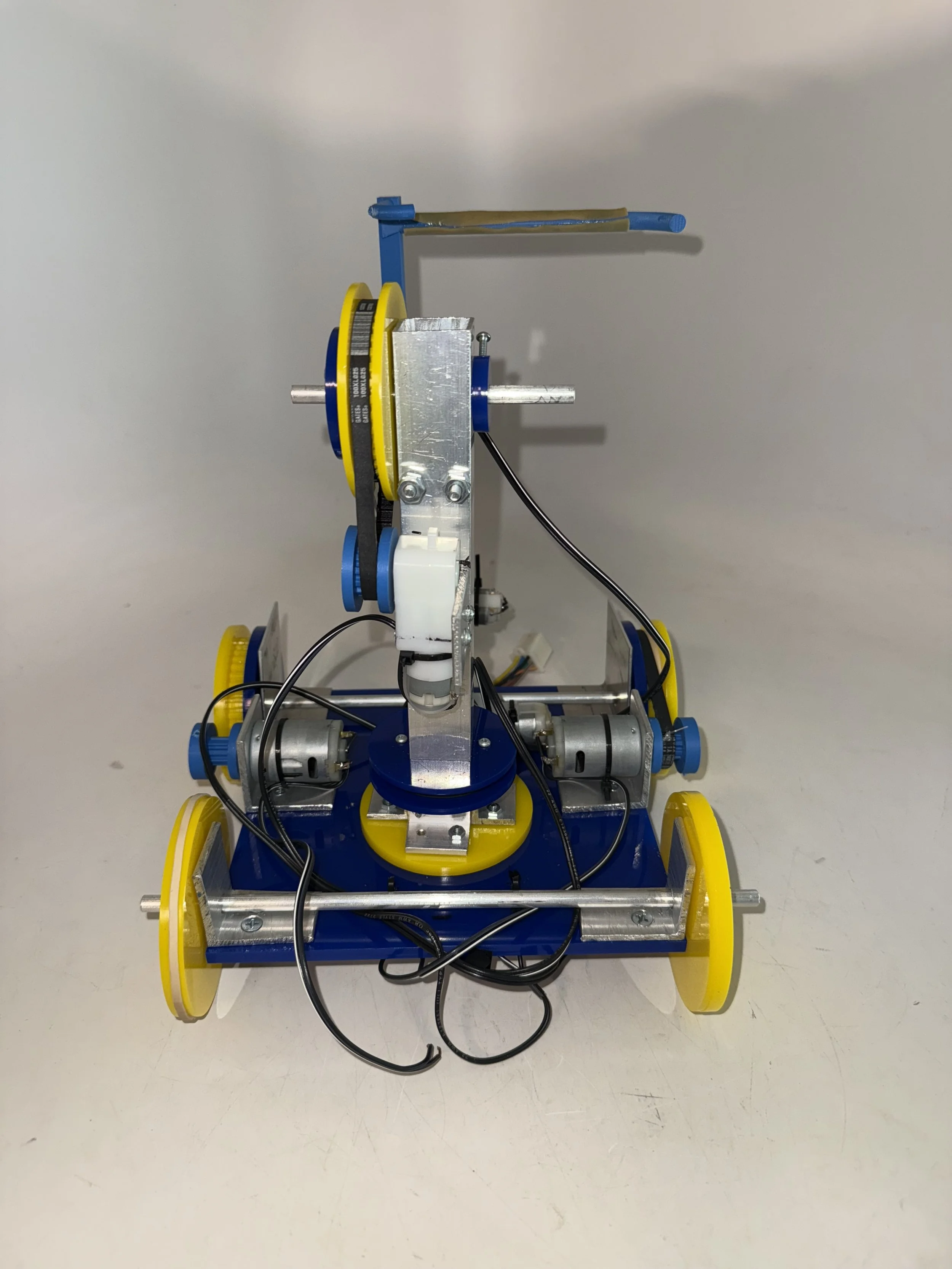
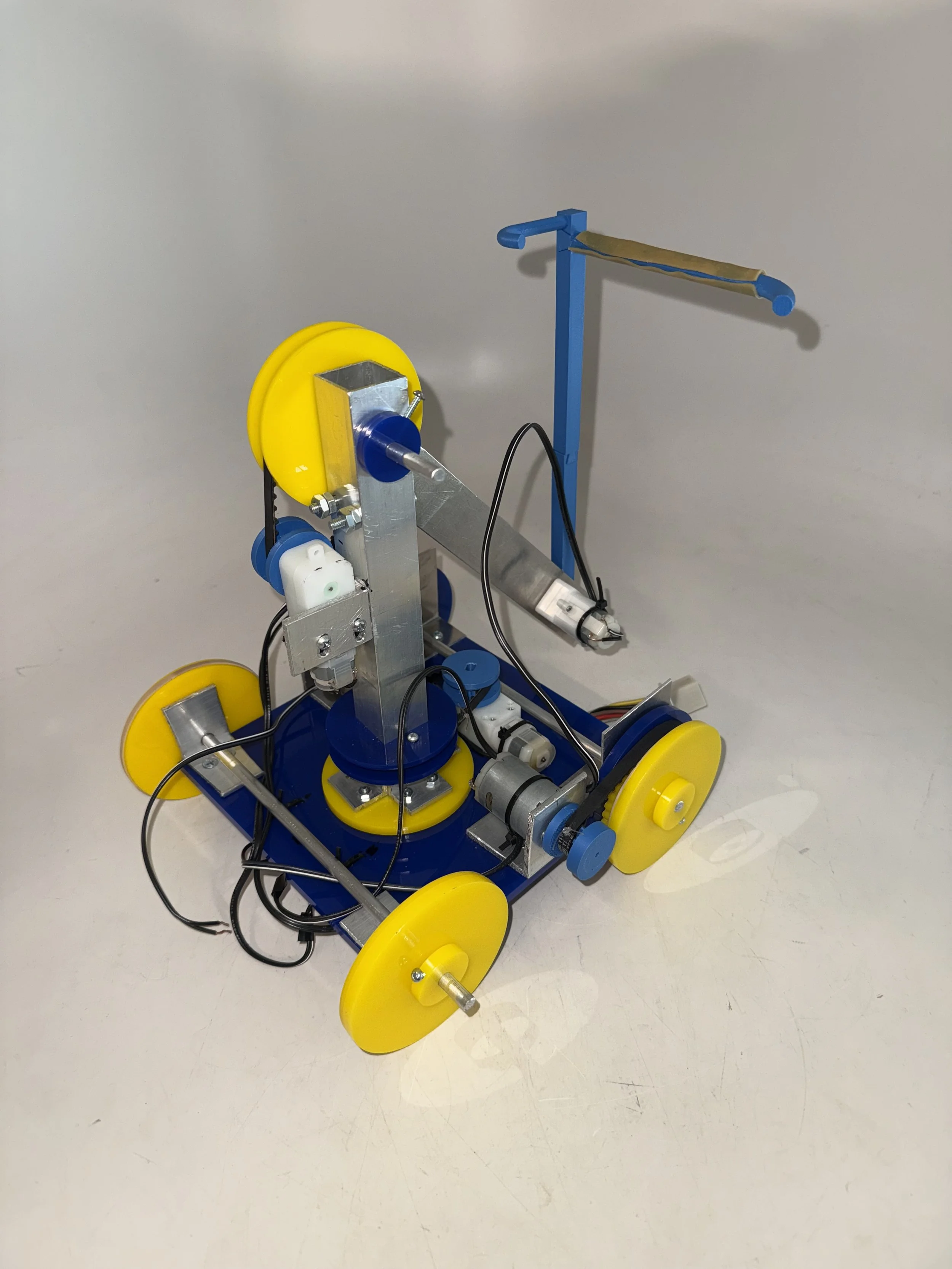
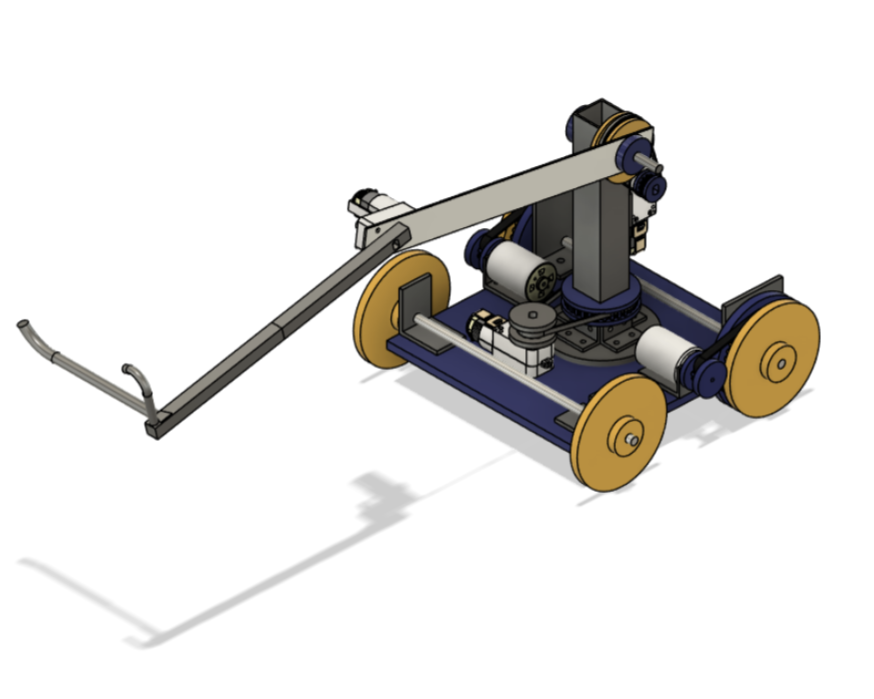
CAD rendering of our full robot!
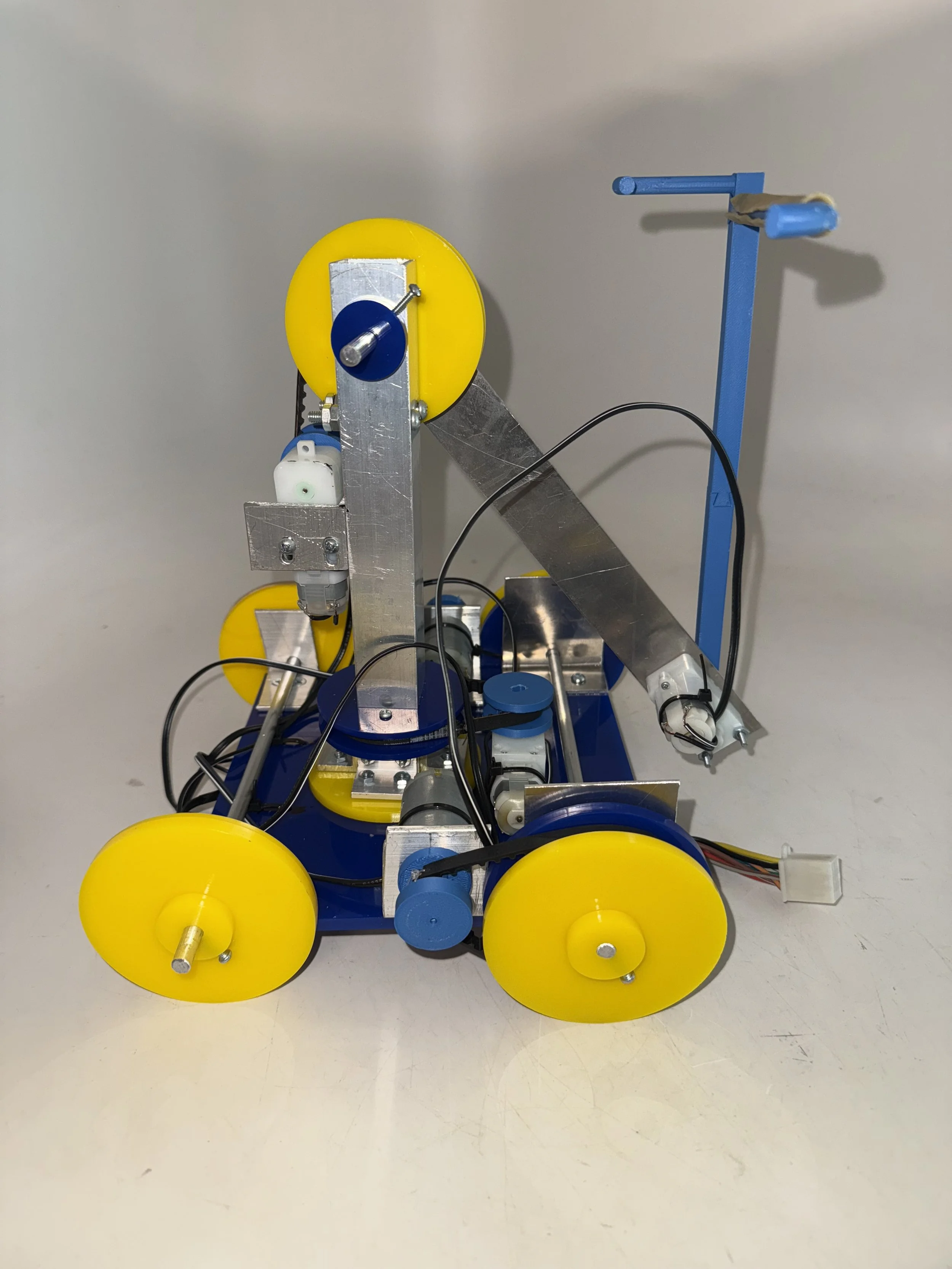
My Component: High-Speed Drivetrain & Moving Cart Base
Role & Design Optimization: Because our tower and arm subassemblies already provided full multi-axis range of motion for handling rings, I intentionally simplified the drivetrain to a single degree of freedom (forward and backward linear travel). This kept the architecture lightweight and eliminated unnecessary mechanical complexity while allowing the base and arm to operate simultaneously.
Iterative Engineering & Prototyping: I originally designed a dual-motor rear-wheel drive setup using two non-geared DC motors. Through physical testing and iteration, I discovered that powering a single rear wheel with one non-geared motor while leaving the other three wheels free-spinning and removing the redundant motor significantly reduced overall mass, boosting acceleration and top speed without sacrificing straight-line tracking.
Competition Performance & Efficiency: The final drivetrain exceeded every functional requirement, reliably carrying a three-ring payload across the 20-inch span in roughly 2 seconds (well under our 5-second target). Across a full 60-second match, total driving time accounted for at most 10 seconds across multiple scoring and collection runs, freeing up more than 80% of match time for precision ring pickup and high-multiplier placement on Sun God.
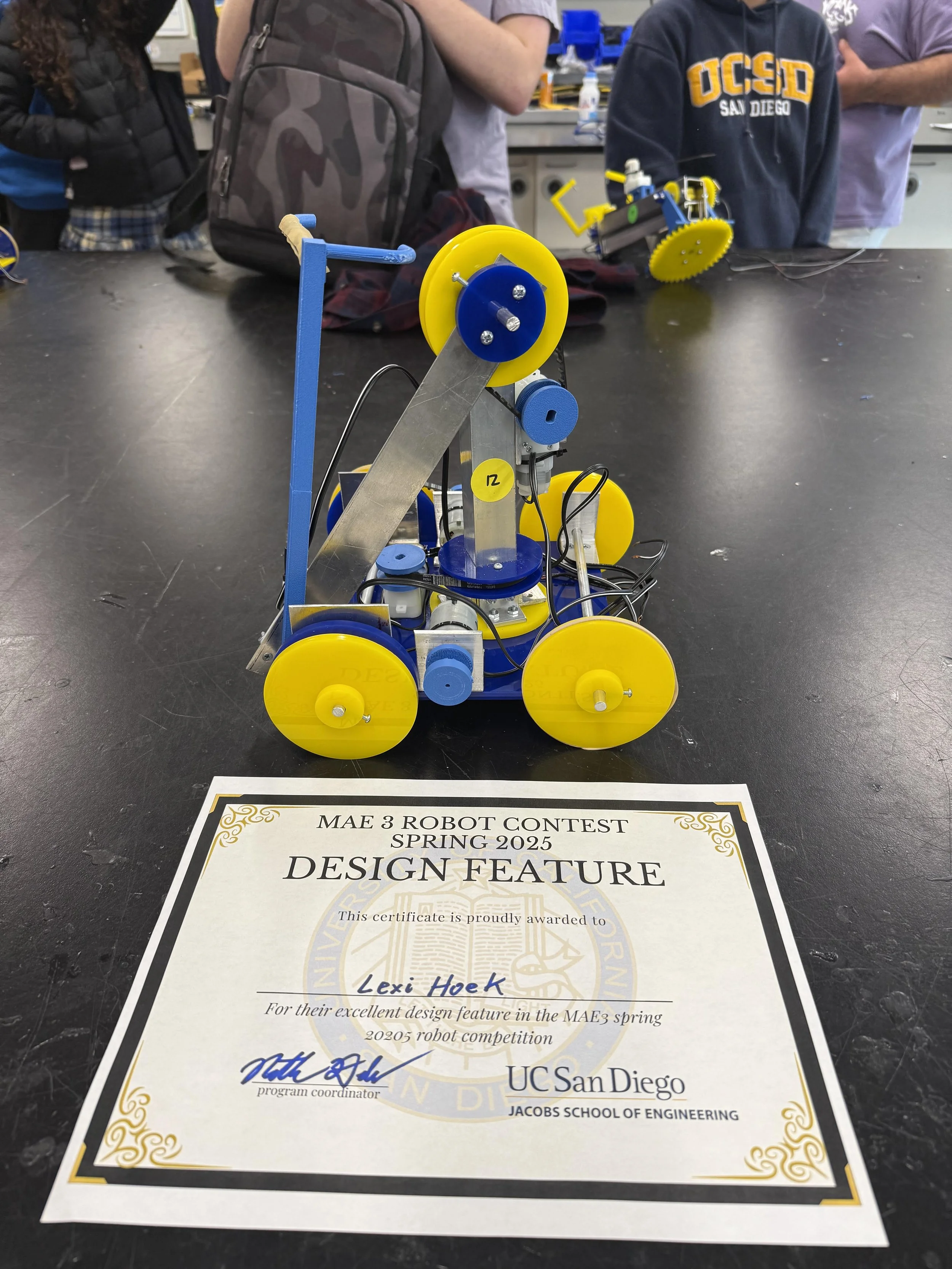
Our drive train’s design award!
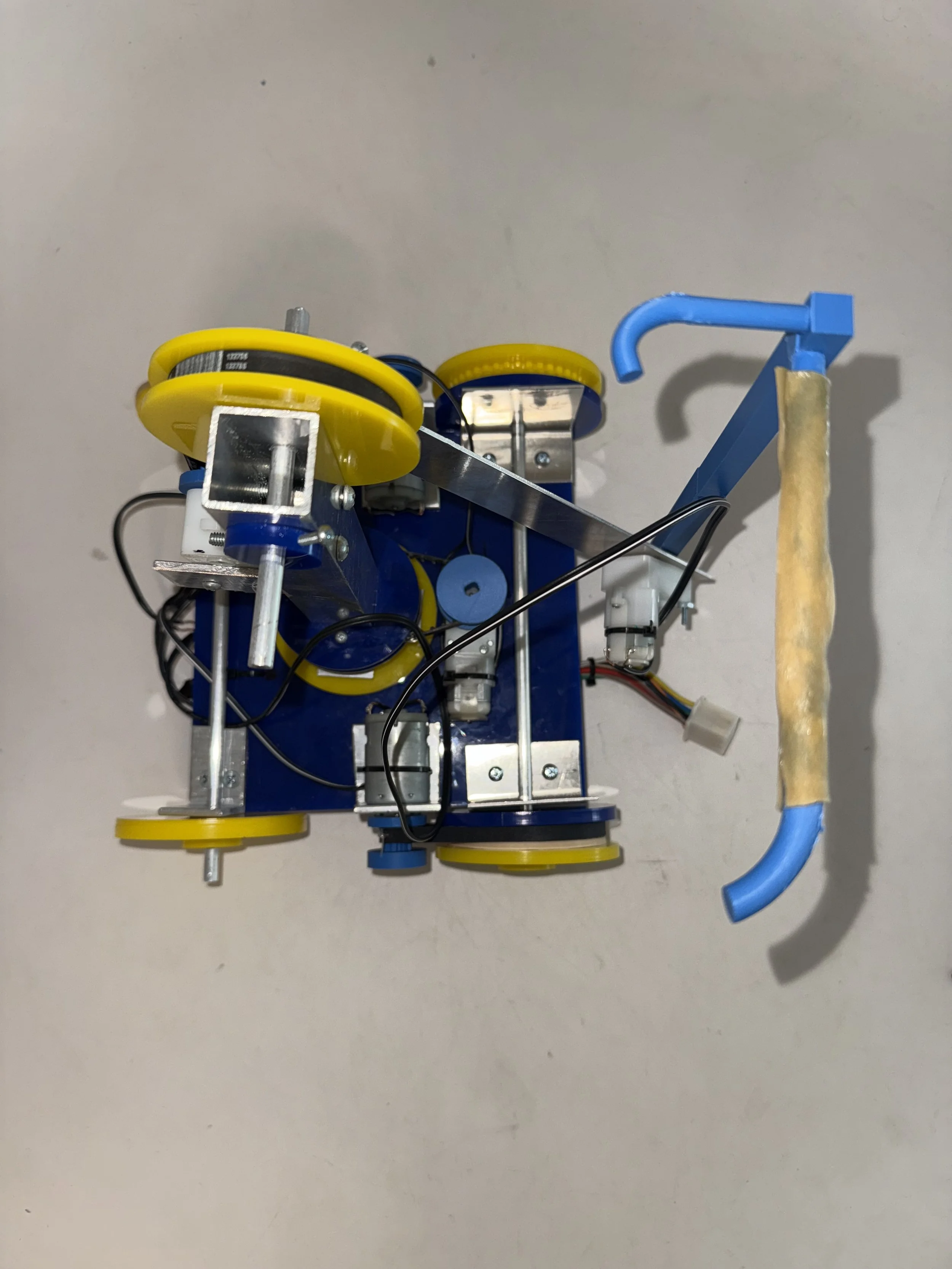
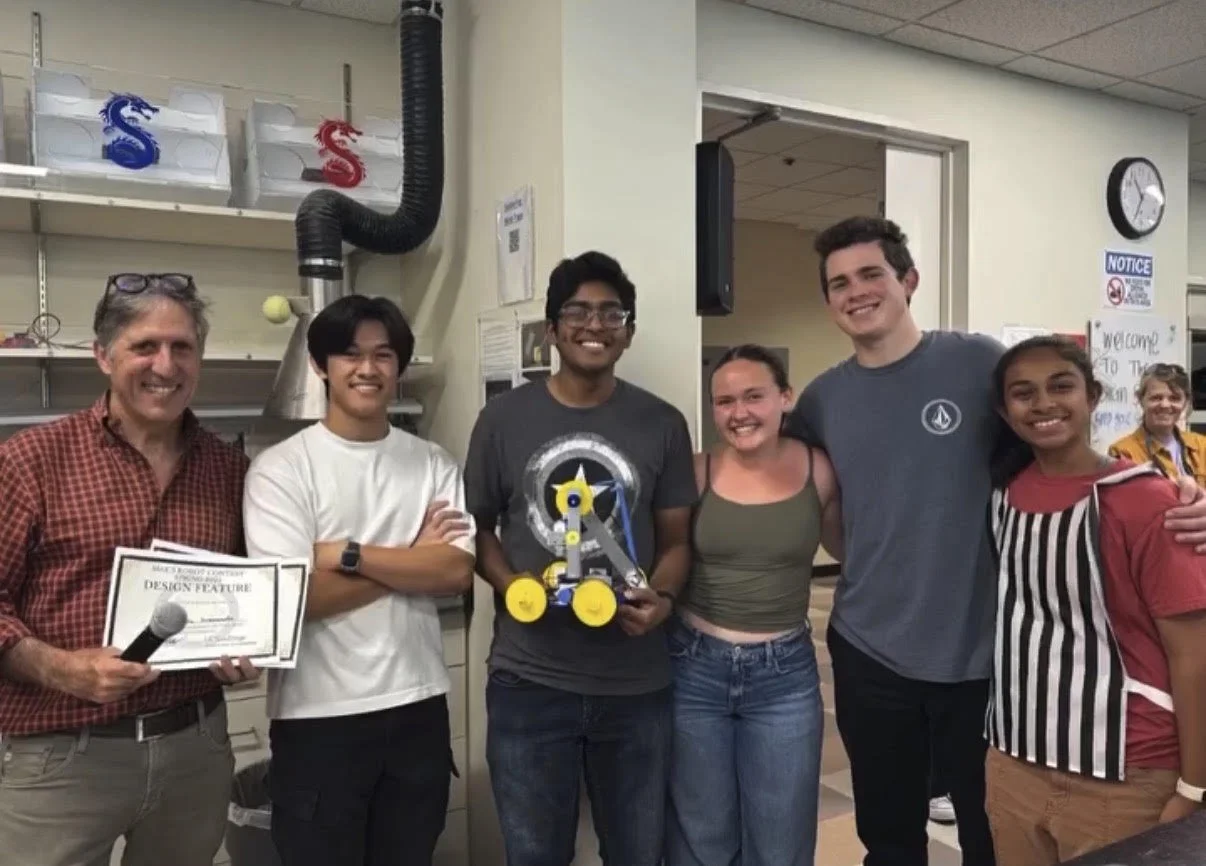
Me and my awesome robot group, our professor Dr. Nathan Delson, and our super helpful teaching assistant Parissa Teli!
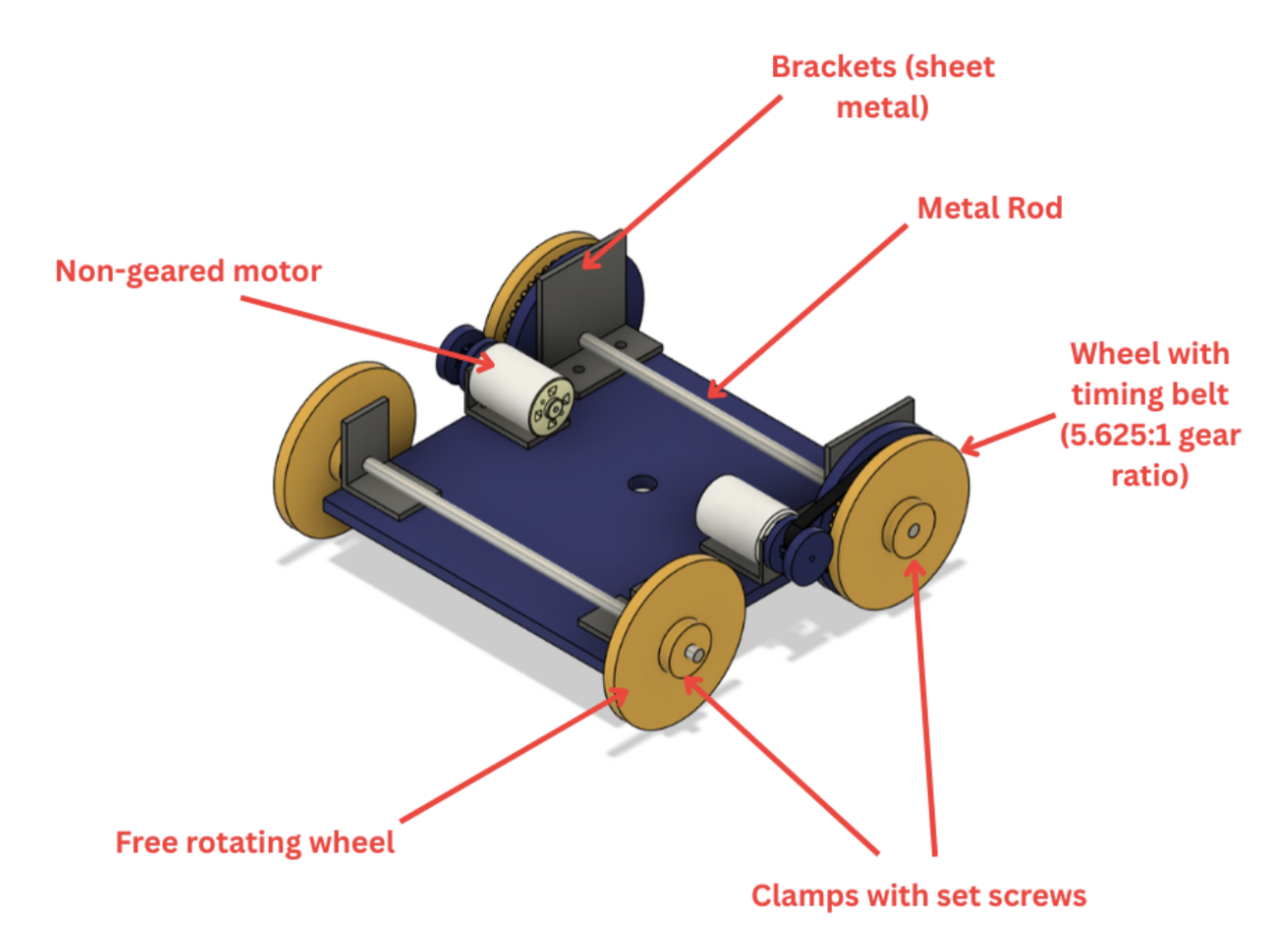
CAD rendering of my component, the drive train!
Teamwork, Ownership, and Competition Recognition
Shared Commitment Over Prior Experience: Entering the class with zero prior fabrication or CAD background, I initially assumed technical tool mastery would determine our success. Through the build, I quickly realized that constant communication, prioritization, and shared accountability mattered far more than starting skill level.
Component Ownership With All-Hands Execution: While each of the four team members owned a specific subsystem from day one, we committed to helping fabricate and troubleshoot every part of the robot together. At least two of us (and usually all four) attended every Design Studio office hour to divide and conquer tasks, backed by a shared to-do list and active group chat so no one ever tackled broken parts, failed prototypes, or lost CAD files alone.
Special Design Award Recognition: That collaborative approach paid off in a reliable, competition-ready machine built on schedule without last-minute panic. At the end of the competition, our team was awarded one of only two Special Design Awards given across the entire class, recognizing the efficiency and innovation of the drivetrain base I led.